

Discover what asian dramas (doramas) are, why they hook so many people, and which are the best Asian series to start with. A complete guide with tips and recommendations.
Find out what Asian dramas are, why so many people get hooked on them, and which series are best for beginners. A complete guide with tips and recommendations.
Have you ever started a show on a random Sunday afternoon out of pure chance and, before you know it, it’s three in the morning, your eyes are tired, but you absolutely need to see the next episode? That happened to me a few years ago when I discovered this type of series.
From that moment on, I completely understood why millions of people around the world are hooked on stories coming out of Asia. If you’ve heard the word “drama” or “K-drama” at work, on social media, or among your friends and you want to understand what this whole thing is about without the fluff, you’re in the right place.
Image generated for illustrative purposes
My first encounter with Asian dramas and how it changed the way I watch TV
So you understand where I’m coming from, I have to confess that for the longest time I was the kind of person who only watched shows produced in the US or Spain. I was used to the same old pacing, the same narrative patterns, and love stories or thrillers that almost always resolved the same way.
I thought Asian dramas were something distant or hard to relate to because of the cultural differences. I couldn’t have been more wrong.
The boring afternoon that changed everything
One winter weekend when I had zero appealing plans, I ended up browsing through a streaming platform’s catalog on my laptop. I spotted the thumbnail for a drama I’d never heard of. The premise seemed simple enough: two people with completely opposite lives who cross paths because of a workplace misunderstanding. I decided to give it twenty minutes out of sheer curiosity.
What happened next genuinely surprised me. The visuals were gorgeous, the music accompanied every scene in an incredibly deliberate way, and the actors brought a level of expressiveness that had me hooked from minute one. I didn’t need more than two episodes to realize I was looking at a completely different way of making television. There was no rush to tell the story, but there were no boring filler moments either. Everything had a clear purpose.
What you’ll find in this step-by-step guide
Throughout this long, detailed article you’re going to uncover all the secrets of this world. We’ll go over the origin of the term, the historical evolution of these shows, the key differences depending on the country they’re produced in, and the main reasons they create such a healthy addiction among viewers of all ages. On top of that, I’ll give you clear pointers on where to start based on your personal taste and answer the most common questions people ask me when they’re approaching this universe for the first time.
What exactly is a K-drama (or Asian drama) and where does the word actually come from
When you hear this term for the first time, it’s totally normal to wonder what it actually covers. Does it only refer to sad, tear-jerker stories? Is it a format exclusive to one country? Let’s clear up the basics so there’s no confusion.
The word itself and how it evolved across Asia
The word “dorama” comes directly from the phonetic adaptation that Japanese makes of the English word “drama.” In Japanese pronunciation, since the consonant cluster “dr” followed by a vowel doesn’t work the same way as in other languages, the word naturally transforms into “dorama.”
Originally, within the Japanese market, this label was used to refer to any fictional series aired on national television, regardless of whether it was a romance, a medical drama, or a comedy.
Over the years, though, as these shows expanded internationally, the term came to be used in Spanish and other Western languages as a general label for TV series produced in East Asia.
While it’s very common today to distinguish between K-dramas for South Korean shows, J-dramas for Japanese ones, C-dramas for Chinese productions, and T-dramas for Taiwanese series, in everyday use the word “drama” still works as a handy umbrella term that covers them all.
The fundamental difference between an Asian drama and a Western show
If I had to boil down in a single idea what sets an Asian drama apart from an American or European series, I’d say the key lies in the structure and the planning from day one of production.
While in the West shows are designed with the goal of renewing for as many seasons as possible as long as ratings hold up, Asian dramas follow the exact opposite approach.
The vast majority of them are conceived as self-contained miniseries. They have a beginning, a middle, and an ending that are all mapped out before the first scene is ever filmed.
Why the single-season format makes all the difference
Knowing from episode one that the story you’re watching is going to wrap up in a matter of weeks brings an enormous sense of relief as a viewer. There’s no feeling that the writers are pulling ridiculous twists out of thin air just to stretch the plot another year. You also never get that bitter taste of a show getting canceled without a proper ending.
This closed structure allows for character arcs that are much more solid and coherent. You watch them evolve step by step, work through their internal conflicts, and arrive at a logical conclusion that makes all the time you invested in watching them feel worthwhile.
A brief look back: from local broadcasts to worldwide success
To understand the level of popularity Asian dramas have reached today, it really helps to look at how this journey has unfolded over the past few decades.
The origins on Asian public television
During the seventies and eighties, television in countries like Japan and South Korea produced content aimed almost exclusively at domestic audiences. These were family melodramas, period stories, or simple comedies that aired during primetime to keep families company over dinner.
Production was modest and the technical resources were fairly limited compared to today’s standards.
Despite that initial simplicity, these shows already carried the seed of what was to come: a special attention to family values, respect for traditions, the importance of friendship, and the pursuit of personal growth in the face of everyday struggles.
The arrival of the Korean Wave, or Hallyu
In the late nineties, a fundamental strategic shift took place, led mainly by South Korea. The government and production companies in the country realized that culture and entertainment could become a top-tier economic engine and export powerhouse. That’s how the concept of Hallyu (the Korean Wave) was born.
They started pouring meticulous care into scripts, training actors in multiple disciplines, and investing significant resources into upgrading filming and editing equipment. Romantic series like Winter Sonata became hits not only in Korea but across Japan, China, and Southeast Asia, proving that well-told stories could cross borders with absolute ease.
The pivotal role of the internet and streaming platforms
The definitive leap onto the global stage happened thanks to two interconnected factors. On one hand, the early fan communities on the internet who voluntarily translated and subtitled episodes so people in other countries could enjoy them.
On the other hand, the rise of on-demand streaming platforms gave the final push. Once these companies saw that Asian series were racking up millions of views, they started adding them to their catalogs with professional subtitles and dubs in multiple languages.
What used to require digging through obscure internet forums was now available with a single click from your living room remote.
The keys to the addiction: why they hook you from episode one
The answer isn’t just one ingredient but a very deliberate combination of narrative, aesthetic, and cultural factors.
The art of slow-burn emotions and romance
In a lot of current Western fiction, the goal is quick impact, instant resolution of tension, and very explicit scenes from the opening chapters. Asian dramas, especially in the romance genre, take the opposite route, and it’s incredibly refreshing.
Here, relationships are built with exquisite patience. You can spend several episodes watching the leads exchange glances at the office, accidentally brush hands while sharing an umbrella, or say important things through small everyday details.
That emotional restraint creates a beautiful kind of anticipation. When a sincere gesture, a confession, or a moment of real closeness finally happens, the viewer feels an enormous sense of satisfaction because they’ve witnessed the entire buildup.
Stunning cinematography and unforgettable soundtracks
Another major strength is the technical and visual execution. The cinematography in these shows is usually handled with impressive attention to detail. The lighting of each shot, the choice of locations, the wardrobe colors depending on the season or the characters’ emotional state… everything radiates visual harmony.
On top of that, there’s the enormous importance given to the original soundtrack, commonly known as the OST. Unlike other shows where background music goes unnoticed, in Asian dramas the main songs are custom-composed for very specific moments in the plot.
The lyrics reinforce what the characters are feeling, and the melodies stick with you. It’s completely normal to hear one of those songs months after finishing a series and instantly recall the exact emotion from that scene.
A window into different cultural codes and social interactions
Watching Asian dramas is also an amazing way to travel without leaving your couch and experience customs that are different from your own. The way people address their elders, the etiquette at work dinners, the weight placed on education, the rituals of courtesy, the neighborhood dynamics: all of it opens a window to a deeply enriching sociocultural reality.
Even though the customs might feel foreign at first, the emotions underneath are exactly the same anywhere in the world: the fear of loneliness, the desire to protect the people we love, the frustration with injustice, or the drive to get better at what we do. That blend of the unfamiliar and the deeply relatable is incredibly appealing.
Types of Asian dramas by country of origin
Even though we tend to group them all under the same word, it’s worth knowing that each country brings its own stamp, acting style, and narrative pacing.
K-dramas: South Korean dramas
These are currently the shows dominating the international market by a wide margin. Korean dramas stand out for their high budgets, near-cinematic production quality, and a remarkable ability to jump between genres within the same story.
In a K-drama it’s perfectly normal to start watching a charming romantic comedy and, as the plot progresses, see elements of crime thriller, critiques of workplace pressure, or deep family dilemmas woven in. They handle dramatic pacing extremely well and typically feature casts of highly trained actors who deliver incredible believability.
J-dramas: Japanese dramas with brevity, realism, and introspection
Japanese series tend to be noticeably shorter than Korean ones, almost always landing between eight and twelve episodes of about forty minutes each. That brevity means the stories get straight to the point without unnecessary detours.
The tone of J-dramas leans more toward slice-of-life, introspective, and focused on the everyday lives of ordinary people. It’s common to find shows dedicated to exploring very specific professions, stories about local food culture, coming-of-age dramas, or quiet reflections on loneliness and friendship in big cities.
They also have a deeply rooted tradition of adapting manga and novels with remarkable faithfulness.
C-dramas and T-dramas: China and Taiwan between historical costumes and youthful energy
Dramas from mainland China fall mainly into two very distinct camps. On one side, there are the historical or traditional fantasy series, known for their spectacular costumes, massive sets, and plots filled with martial arts and political intrigue. On the other, you’ll find modern romances set in universities or tech companies.
Taiwanese series, for their part, are known for their freshness, their straightforward humor, and their easygoing tone. They were pioneers in adapting youthful romance stories that defined an entire generation of viewers in the early 2000s and they still maintain a signature style that’s very approachable and likable.

Image generated for illustrative purposes
The major genres explained
One of the clearest perks I’ve discovered over time is that no matter what kind of story you’re in the mood for at any given moment, there’s always an Asian drama out there that fits your vibe perfectly.
Romantic comedy and office romances
This is the quintessential gateway genre and the one that tends to rack up the most fans worldwide. The structure usually relies on very clear dynamics: two people forced to work together, strict bosses who turn out to have a huge heart once they leave the office, or childhood sweethearts who cross paths again years later when both have changed.
What’s great about these stories is how well they handle humor. They don’t go for cheap laughs through crude jokes; instead, they create absurd but endearing situations that snowball in the most delightful way.
It’s the perfect type of show to watch at the end of the day, when you need to clear your mind from daily stress and want something that leaves you feeling good before bed.
Thriller, mystery, and crime investigation
If you prefer darker stories that keep you glued to the screen, the range of suspense dramas is massive. Asian series in this space stand out for building investigative plots where the psychology of the characters weighs just as much, if not more, than gathering evidence.
It’s very common for the main storyline to revolve around a cold case from years ago that gets reopened thanks to a new piece of evidence, or to follow a group of honest detectives fighting corruption within their own institutions.
The writers are also absolute masters at leaving you with an unexpected revelation at the end of every episode that makes it physically impossible to turn off the screen.
Fantasy, time travel, and traditional folklore
The fantasy genre in Asian dramas has a very unique identity because it draws from the mythology and folk legends of its own culture. It’s common to find characters like nine-tailed foxes, deities who oversee human destiny, or grim reaper figures who accompany souls on their journey.
Time-travel dramas are also hugely popular, where the main character is transported several centuries into the past after an accident or through a mysterious portal, and has to adapt to life in the imperial era while searching for a way back to the present.
The beauty of these shows lies in how effortlessly they weave the magical into deeply human emotional dilemmas.
Workplace, medical, and legal dramas
For anyone who enjoys getting a behind-the-scenes look at demanding professions, shows set in hospitals, law firms, or major corporations are an excellent choice.
Unlike what sometimes happens in Western TV where the job is just a backdrop, in these dramas the characters’ professional growth takes center stage in the plot.
They show with unflinching honesty the level of pressure, the rigid workplace hierarchy, and the grueling schedules workers face in those countries. You watch the characters fight to maintain their ethical integrity, learn from their mistakes, and search for a balance between their career ambitions and their personal lives.
Historical period dramas
Known commercially as sageuks in South Korea or imperial court dramas in China, these series transport you to ancient kingdoms filled with protocol, family dynasties, and majestic palaces.
Don’t let the traditional attire or the formal speech at the beginning intimidate you. At their core, these are gripping stories centered on internal power struggles for the throne, secret alliances between noble families, impossible romances across social classes, and political conspiracies. The settings are usually breathtaking, and the level of detail in the costumes is genuinely stunning.
Slice-of-life stories
On the opposite end of the spectrum from big action or fantasy series sits this quiet, deeply human genre. There are no major villains to defeat and no mysteries to solve against the clock.
The plot simply follows a group of friends, the neighbors of a modest neighborhood, or the members of a small team through their everyday lives. It shows us their conversations around a table, their doubts about the future, their family dinners, and the way they support each other through loss and disappointment.
These are deeply comforting shows that make you feel like part of the group.
How to pick your first Asian drama based on your personal taste
When you peek into a catalog for the first time and see hundreds of titles available, it’s totally normal to feel a bit overwhelmed and not know what to click. To keep you from getting tired of searching before you even start, I want to share the method I use myself whenever I’m choosing a new series.
Think about what kind of content you usually enjoy
The most common beginner mistake is going straight for whatever title is trending at the moment without checking whether the genre actually matches your usual taste. If you don’t typically enjoy romance in movies or Western shows and you prefer crime thrillers, don’t start your journey with a bubbly teen rom-com just because it’s popular.
Ask yourself a few simple questions before choosing:
Do you want a lighthearted story that’ll make you smile, or a complex plot that’ll make you think? Are you in the mood for modern, urban settings, or would you rather travel to a different historical era? Are you looking for a story focused on two people, or do you prefer ensemble casts where many characters matter?
Answering these will narrow your search down to two or three specific genres, which makes the final decision so much easier.
Apply the three-episode rule
It’s really important to keep in mind that Asian storytelling sometimes needs a short runway to get going. The first episode usually introduces a ton of characters, the dynamic between them, and the initial conflict, so it can feel a bit dense if you’re not used to the names or the cadence of the language.
My advice is to always apply the three-episode rule. Give it that chance. In the first episode you get your bearings, in the second you understand the relationships between the characters, and in the third the story usually takes off for real.
If after watching the third episode you feel zero curiosity about what happens next, drop it guilt-free and move on to the next one. There’s way too much great content out there to force yourself through something that isn’t clicking.
Ignore fleeting trends if they don’t fit you
We’ve all been in that situation where our social media feeds are blowing up over a specific show that everyone seems to be watching. It’s easy to give in to curiosity and start it just so you’re not left out of the conversation.
My experience has taught me, though, that the shows you enjoy the most are the ones you choose out of genuine interest, not social pressure. If a title has great reviews but the premise doesn’t catch your eye, save it for later or skip it entirely. Your free time is valuable.
Platforms, subtitles, and how to watch
Once you know what kind of story you want to watch, it’s time to sort out the practical side: how and where to access these shows comfortably and in good quality.
Where to watch Asian dramas with professional English subtitles
Fortunately, the current landscape couldn’t be better for fans of Asian fiction. The legal options for accessing large catalogs are extremely varied.
Major general-purpose streaming platforms have added a massive number of Asian titles to their libraries. They typically offer high-quality subtitles and even English dubs for the most popular shows.
Platforms that specialize in Asian content are the true paradise for anyone looking to go deeper. They offer a huge catalog that updates almost in real time with broadcasts in Seoul or Tokyo. They have apps for smart TVs, phones, and tablets, and let you enjoy hundreds of series for free with ads or through a very affordable monthly subscription.
The eternal debate: original language with subtitles or dubbed?
A lot of people prefer dubbed content so they can follow the story while doing other things around the house.
While I totally understand the convenience of a dub in certain moments, I’d encourage you to make the effort to watch in the original language with subtitles from the start. The vocal performances in Asian languages carry a level of nuance, breathing, pauses, and respect for linguistic hierarchy that’s nearly impossible to replicate in a Western dubbing studio.
After a few episodes, your brain gets used to reading the text almost automatically without missing anything happening on screen. Plus, you’ll start picking up everyday words, polite expressions, and tones that’ll help you understand the characters’ intentions on a much deeper level.
Episode length and how to pace yourself
As I mentioned at the beginning, episodes in Asian dramas, especially Korean ones, tend to run a bit longer than what we’re used to. A standard episode usually lands somewhere between sixty and seventy-five minutes.
To avoid eye fatigue or the feeling of never having enough time during the week, a good trick is not to approach your watching like a race.
Enjoy one episode per night like it’s a mini movie. There’s no rush to finish a series in two days. Savoring the story at a comfortable pace lets you grow much more attached to the characters and gives the plot the breathing room it deserves.
The community phenomenon and the emotional hangover after the finale
Sharing reactions and theories on social media and fan groups
Watching Asian dramas doesn’t have to be a solo experience. When you finish an episode packed with plot twists or an ending that leaves your jaw on the floor, the first thing you want to do is talk about it with someone.
Online, there are countless forums, social media accounts, and group chats where people of all ages share their takes on the week’s premieres.
They’re a fantastic space for reading different interpretations of the same scene, catching cultural details you might have missed, or getting personalized recommendations based on your favorite titles.
How to get through the post-drama emotional hangover
Sooner or later it’s going to happen: you’ll finish a sixteen-episode series you were completely invested in, the characters will have felt so real they became part of your daily life, and when the final credits roll on the last episode you’ll feel this strange emptiness in your chest. It’s what the community affectionately calls the drama hangover.
To get past this feeling of disconnection without falling into TV apathy, the best move is a drastic genre switch for your next pick.
If you just finished an intense, emotionally heavy story that made you cry, don’t try to find something similar right away because the comparisons will be unavoidable. Jump straight into a lighthearted comedy with short episodes or an action series that has nothing in common. That helps your mind reset naturally.
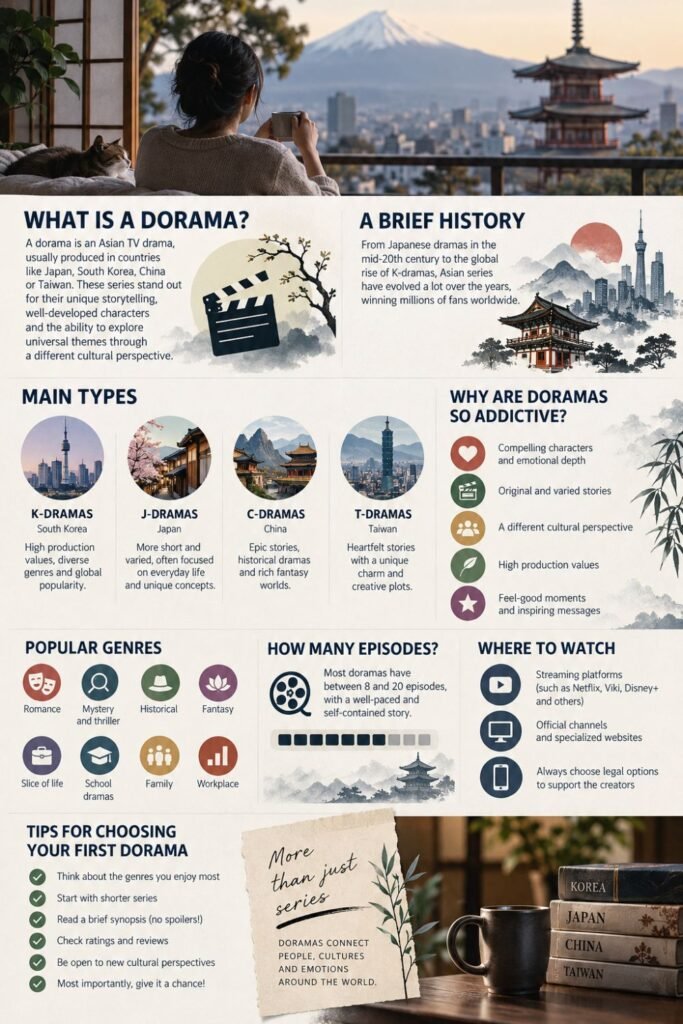
Asian drama summary infographic
Frequently asked questions about Asian dramas
Why do the characters take so long to have their first kiss or show affection?
This ties directly to the customs and social codes of the countries where these shows originate. In societies like South Korea or Japan, public displays of physical affection aren’t as common as in the West and tend to be reserved for strictly private settings.
Asian dramas reflect that restraint and prefer to build romance through meaningful glances, acts of mutual care, deep conversations, and respect for personal space. That initial reserve is exactly why, when a moment of real closeness finally happens, the scene carries an enormous emotional impact within the story.
Is it true that a lot of the lead actors are also pop singers?
Yes, it’s an extremely common practice in the Asian entertainment industry. Many of the stars we see on screen started their careers in pop music groups or K-pop. In those countries, talent agencies train young performers in acting, dancing, singing, and physical expression for years. It’s very common for an actor to not only play the lead role in a series but also sing one of the key songs on the soundtrack.
What do words like oppa, unnie, or noona mean that you hear constantly?
These are honorific terms used in South Korea to address other people based on age and gender. There isn’t a single-word English translation because they depend on social context. For example, a young woman uses the word oppa to address an older brother, an older male friend, or her boyfriend. Similarly, a young man uses the word noona to address an older female friend or sister. Using these terms shows both closeness and respect within a conversation.
Why are there so many scenes of characters eating or drinking together?
Food in Asian cultures is a fundamental pillar of socializing and family care. Sharing a meal with someone, serving food onto their plate, or offering them a warm bowl of soup is a direct way of showing affection, concern, or a desire to make amends.
That’s why many of the most sincere and important conversations between characters take place at local restaurants, street food stalls, or around the kitchen table at home.
Are there Asian dramas aimed at a more adult or mature audience?
Absolutely. While youth comedies get a lot of visibility on social media, the selection of dramas aimed at adult viewers is enormous. There are outstanding series centered on the challenges of motherhood, divorce, the midlife crisis, career changes in middle age, or the difficulties of caring for aging parents. These stories are told with extraordinary maturity, elegance, and psychological realism.
Are the plots always romantic, or are there options for people who don’t want love stories?
Not every series includes romantic storylines. There are tons of productions focused exclusively on solving crimes, historical political conspiracies, survival in sci-fi settings, or overcoming athletic challenges.
If love stories aren’t your thing, you’ll find a massive catalog of thrillers and action series where romance is either completely absent or entirely secondary.
As you’ve seen, the world of Asian dramas is far bigger, more varied, and richer than it might seem from the outside. This isn’t simply a trendy type of show; it’s a different way of telling stories that pays attention to the details, respects emotional pacing, and lets us peek into fascinating cultures without ever leaving our couch.
I hope this guide serves as a solid roadmap so you can take your first steps on the right foot without wasting time on blind searches. If you manage to find the right series for where you are in life right now, I promise you’re going to love the experience.
So, have you already watched an Asian drama that really stood out to you, or are you looking for recommendations to kick things off this weekend? If you have any questions about where to start or want help picking a title based on your personal taste, drop me a comment below. I promise I’ll read it carefully and happily point you toward your next favorite story.
See you in the comments!